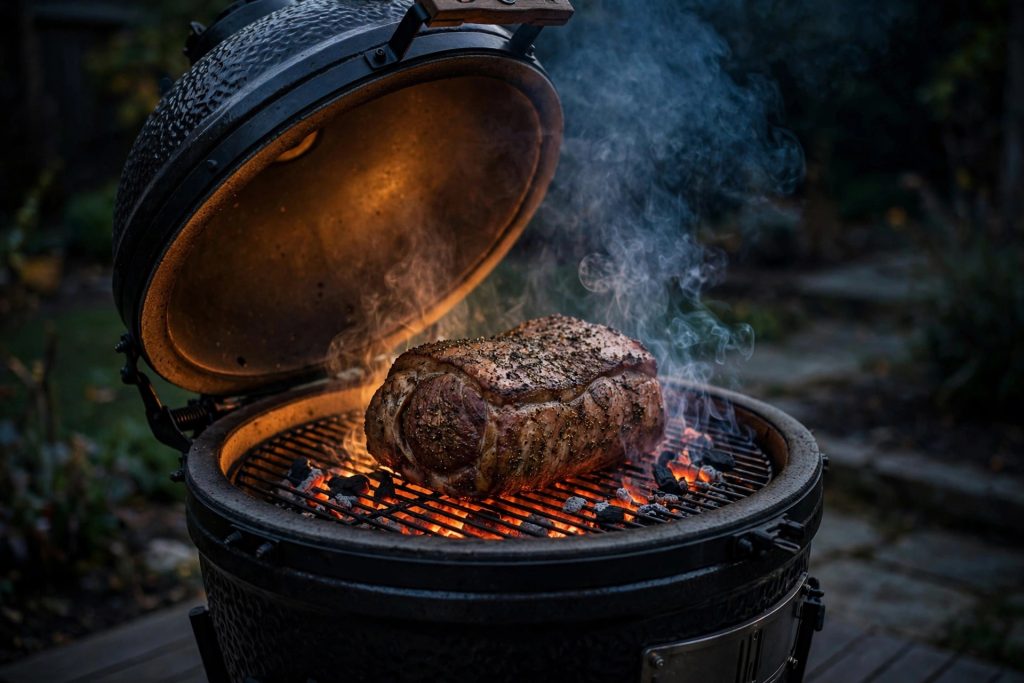
You don’t need a thousand dollars to cook on a kamado, but under $500, you do need to know what you’re trading away. We compared specs, retailer listings, and owner feedback on every kamado that realistically streets below $500 to find the ones worth buying.
This post contains affiliate links. We may earn a commission at no extra cost to you.
The short answer
For most people, the Char-Griller Akorn is the budget kamado to buy: around $400 gets you a full-size 20-inch cooking grate, kamado-style temperature control, and low-and-slow capability, in insulated steel instead of ceramic. If you want real ceramic under $500, your options split in two: go small with the Kamado Joe Joe Jr (lists at $499.99, often discounted), or go warehouse-club hunting for a full-size Vision Grills ceramic when it goes on sale. The Akorn Jr at around $200 is the portable wildcard.
This guide is the budget companion to our full kamado grill buying guide, which covers the premium ceramics in depth.
How we picked these
We didn’t get free grills from anyone, and this isn’t a lab test. We pulled manufacturer spec sheets and current retailer listings, then cross-checked against what owners report about heat retention, durability, and parts support. One important filter: a kamado only made this list if it genuinely sells under $500 today. Prices move with sales, so check current pricing before you buy; the figures below reflect listings we checked for this guide.
The picks at a glance
| Model | Street price | Material | Cooking area | Weight / portability |
|---|---|---|---|---|
| Char-Griller Akorn | Around $400 | Triple-wall insulated steel | 314 sq in primary (447 with warming rack) | ~97 lbs, on a wheeled cart, easy to move around a patio |
| Char-Griller Akorn Jr | Around $200 | Triple-wall insulated steel | 155 sq in | 33 lbs, genuinely portable, tailgate-ready |
| Kamado Joe Joe Jr | $499.99 list, often ~$350 on sale | Ceramic | ~150 sq in (13.5-inch grate) | ~77 lbs, luggable by one strong person, not light |
| Vision Grills (warehouse-club models) | $399–$449 on sale (list $550–$700) | Ceramic | ~300 sq in single-tier, up to 604 sq in two-tier | 200+ lbs, pick its spot and leave it there |
Char-Griller Akorn: the default budget pick
The Akorn is the grill that made this price tier exist. Instead of ceramic, Char-Griller builds the body from triple-walled, insulated steel with a porcelain-coated interior, and sells the standalone grill for $399.99 on its own site (a cart version runs $449.99). You get a 20-inch cast iron cooking grate, 314 square inches of primary cooking space plus a 133-square-inch warming rack, and a manufacturer-rated range of 200°F to 700°F. That’s full kamado versatility: low-and-slow brisket on Saturday, screaming-hot pizza or steak sear on Sunday.
Steel cuts both ways. At roughly 97 pounds on its cart, the Akorn is less than half the weight of a full-size ceramic, and it can’t shatter if it gets knocked over, a real failure mode for ceramic. The flip side is heat retention: steel walls, even triple-walled and insulated, don’t hold and radiate heat the way thick ceramic does, and steel can rust over the years in a way ceramic simply can’t. Owners who keep an Akorn covered generally report years of good service; owners who leave it in the rain tend to report a shorter life. Char-Griller covers the grill body for 5 years, with shorter terms on parts like the ash pan.
One practical note: for indirect smoking you’ll want the Akorn’s Smokin’ Stone heat deflector, which is sold separately. Budget for it, it’s the accessory that turns the Akorn from a good grill into a good smoker.
Char-Griller Akorn Jr: the $200 portable
The Akorn Jr shrinks the same formula down to 155 square inches and 33 pounds for $199.99 at Char-Griller, and it frequently sells for less at big-box stores. It’s the only kamado on this list you’d actually throw in a truck bed for tailgating or camping, locking lid, carry handles, same 200°F to 700°F rated range as its big brother.
Be honest with yourself about size, though. A 14-inch grate handles burgers for a small group, a couple of steaks, or a small pork butt. It will not handle a full packer brisket or ribs laid flat without some creativity. As a second grill, a small-space grill, or a cheap way to learn kamado cooking before committing real money, it’s genuinely hard to beat.
Kamado Joe Joe Jr: real ceramic, real small
The Joe Jr is the only way to get a genuine ceramic Kamado Joe under $500, and only just. It lists at $499.99 on Kamado Joe’s site, though retailers discount it regularly (we found it at $349.99 during this research, and warehouse-club clearances have gone lower). For that you get a thick-walled ceramic body with a 13.5-inch stainless grate and roughly 150 square inches of cooking space, a 225°F to 750°F heat range, and the heat retention and moisture-locking behavior that make people fall in love with ceramic in the first place. It arrives well-equipped, too: ceramic heat deflector, ash tool, and grill gripper are in the box, along with a cast iron stand.
The compromises are size and weight. At about 77 pounds, “portable” is doing some marketing work, it’s movable, not light. And like the Akorn Jr, the cooking surface is a two-person or small-family proposition. What you’re really buying is the ceramic experience and Kamado Joe’s limited lifetime warranty on the ceramic components, in miniature. If you cook mostly for one or two and want the real thing, this is the pick. (For how the full-size Joes stack up against the other premium icon, see our Big Green Egg vs Kamado Joe comparison.)
Vision Grills: the warehouse-club ceramic
Vision is the quiet answer to “full-size ceramic under $500.” Its 22-inch-class ceramic kamados carry list prices in the $550 to $700 range, but warehouse clubs, Sam’s Club in particular, regularly discount them into this budget: we’ve tracked the 1-Series at $399 against a $549.99 list, and the B-Series Deluxe at $449 against a $699 list. For that money you get actual full-size ceramic: roughly 300 square inches on a single-tier model, up to 604 square inches across two-tier flip grates on deluxe versions, a removable ash drawer, and a limited lifetime warranty on the ceramic parts.
The catch is availability and heft. The under-$500 prices are promotional, not everyday, you may have to wait for a sale and have the right club membership. And at 200-plus pounds, a full-size Vision is a two-person, pick-a-permanent-spot purchase. Catch the timing right, though, and it’s the most grill on this list per dollar.
What happened to the Costco Louisiana Grills kamado?
Longtime deal-hunters will ask about the Louisiana Grills 24-inch ceramic that used to be Costco’s budget legend at around $600. It’s drifted out of this conversation: recent Costco pricing puts it around $900. Still a lot of ceramic for the money, but not a sub-$500 grill, so it’s not in this roundup.
What you give up vs. a $1,000+ ceramic
Every grill above is a compromise in at least one of these ways. Know which ones apply to your pick:
- Material. Steel (the Akorns) insulates well but doesn’t match ceramic’s heat retention or fuel efficiency over a 12-hour cook, and it can rust. Budget ceramics get the material right but shrink the grill to afford it.
- Size. A flagship 18- to 24-inch ceramic is a cook-for-a-crowd tool. Under $500, full cooking area comes only with steel or a warehouse-club sale.
- Accessory ecosystem. Kamado Joe and Big Green Egg have deep catalogs, rotisseries, divide-and-conquer systems, expansion racks. Budget brands offer the basics (deflector stones, covers) and not much more.
- Warranty depth. Premium ceramics typically carry lifetime coverage on the ceramic body. Budget coverage is shorter and more conditional, 5 years on the Akorn’s body, for example.
- Fit and finish. Hinges, gaskets, vents, and thermometers on $1,000+ grills are simply better machined. Budget versions work, but budget is where sloppy lids and vague dampers live.
When you do step up to that class, Saffire is one of the direct-sale names in it. Buying direct from Saffire? Use code M5P7M3Z at checkout.
Who should buy which
Buy the Akorn if you want one full-size kamado that does everything, smoke, sear, bake, at the lowest everyday price, and you’re willing to keep it covered and maintained. It’s the right first kamado for most households.
Buy the Akorn Jr if portability is the point, tailgates, camping, apartment balconies, or you want a low-risk way to learn kamado cooking before spending real money.
Buy the Joe Jr if you cook for one or two, want genuine ceramic performance and a lifetime ceramic warranty, and can catch it on sale. It’s the connoisseur’s budget pick.
Buy the Vision if you have a warehouse-club membership, patience to wait for a promotion, and help to move 200+ pounds once. It delivers the closest thing to the flagship experience under $500.
Skip the budget tier entirely if you regularly cook for six or more, plan to keep this grill for a decade-plus, and know you’ll want the big accessory catalogs. In that case, save longer and start with our main kamado buying guide, buying once costs less than buying twice.
The honest downsides of budget kamados
- Heat deflectors are often extra. The Akorn’s smoking stone is a separate purchase, and indirect cooking is half the point of a kamado.
- Small grates are really small. 150 square inches cooks dinner for two, not a party. Measure your typical cook before choosing a Jr.
- Steel rusts. The Akorns reward owners who cover and season them, and punish owners who don’t.
- Ceramic is fragile in transit. Budget ceramics ship freight or come home in your vehicle, inspect for cracks before you assemble, not after.
- Sale prices require patience. The Joe Jr and Vision picks assume discounts that come and go; at full list, the math changes.
FAQs
Is a cheap kamado grill actually worth it?
Yes, with the right expectations. A $400 Akorn delivers the core kamado experience: charcoal flavor, wide temperature range, real low-and-slow capability. What you don’t get is ceramic’s heat retention, lifetime durability, and accessory depth. For learning the style and cooking for a household, the budget tier is smart money.
Is steel as good as ceramic for a kamado?
Not quite, and the gap is specific. Thick ceramic holds low temperatures steadier on less fuel and shrugs off decades of weather. Insulated steel gets close on temperature range and everyday cooking, weighs far less, and can’t crack, but uses a bit more charcoal on long cooks and can rust if neglected. Most owners taste no difference in the food.
What size kamado do I need?
Work backwards from your biggest regular cook. A 13.5- to 14-inch grate (the Jr models) suits one to three people. An 18- to 20-inch grate, the full-size Akorn’s class, handles family cooks and a brisket or a couple of pork butts. Two-tier grates, like the Vision’s, stretch a mid-size grill further than grate diameter alone suggests.
Should I wait for a sale to buy a budget kamado?
If you’re buying the Joe Jr or a Vision, yes, both picks depend on discounts that recur through the year, especially around holiday weekends and Black Friday. The Akorns are fairly priced every day, though they dip too. None of these is a buy-at-any-price emergency purchase.
Why isn’t there a budget Big Green Egg?
Because Big Green Egg doesn’t discount into this tier, even its smallest model, the MiniMax, sits well above $500. The Egg’s value story is warranty and ecosystem, not price. Our Egg vs. Kamado Joe comparison breaks down where that money goes.
Bottom line
Under $500, kamado buying is about choosing your compromise. The Char-Griller Akorn trades ceramic for steel and wins on size-per-dollar. The Joe Jr keeps the ceramic and trades away the size. The Vision, on sale, cheats the trade-off entirely, if you can catch it and move it. Pick the compromise that matches how you actually cook, and the budget tier will treat you well.
Pitmaster Path is reader-supported. When you buy through links on this page, we may earn a commission at no extra cost to you.