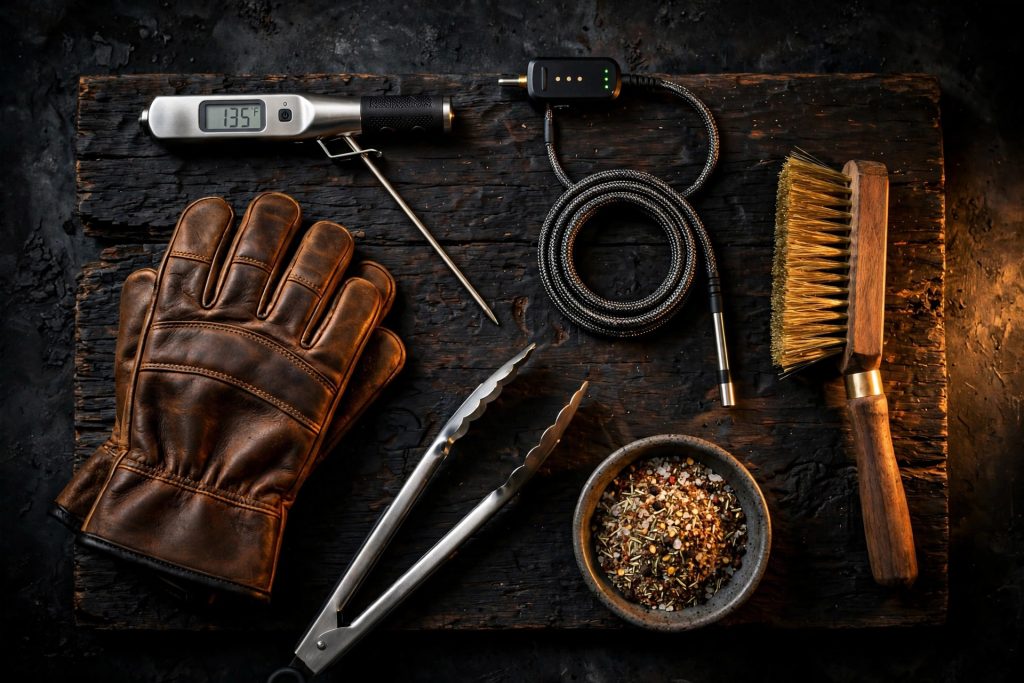
Most grill tool sets are a numbers game: 20 pieces, most of which you’ll never touch, built down to a price. Five tools do nearly all the work at a grill. We compared specs, listings, and owner feedback to find the kit that actually matters, and the filler worth skipping.
This post contains affiliate links. We may earn a commission at no extra cost to you.
The short answer
Buy five things individually and buy them well: 16-inch locking tongs (OXO’s Good Grips grilling tongs, around $20), a sturdy wide spatula (Weber’s Precision Grill Spatula, around $18), an instant-read thermometer (the most important tool on this page, ThermoWorks’ Thermapen ONE if the budget allows), a bristle-free grill brush (BBQ-AID’s replaceable-head brush, around $35), and heat-proof gloves (aramid gloves like Grill Armor’s, around $30). Bought piece by piece, that kit lands around $150–$200 and outlasts any boxed set at the same money. Add a GrillGrate sear surface later if you chase crust.
How we picked these
We didn’t get free tools from anyone, and this isn’t a lab test. We pulled manufacturer specs and current retailer listings, then cross-checked against what owners report about durability and the ways cheap tools fail, bent spatulas, melted handles, brushes that shed. Prices reflect listings we checked for this guide; they move with sales, so confirm before you buy.
The core kit at a glance
| Tool | What to look for | Rough price tier |
|---|---|---|
| Long tongs | 16-inch stainless, locking, scalloped edges that grip without tearing | ~$20 (OXO Good Grips) |
| Spatula | Wide head, thin beveled edge on multiple sides, stiff, not springy, blade | ~$18 (Weber Precision) |
| Instant-read thermometer | Reads in 3 seconds or less, accurate to about ±1°F, folding probe | ~$40–$115 (ThermoPop 2 to Thermapen ONE) |
| Grill brush | Bristle-free coil or scraper design, replaceable head, 17–18 inch handle | ~$35 (BBQ-AID bristle-free) |
| Heat-proof gloves | Aramid fiber, five-finger dexterity, silicone grip, rated heat resistance | ~$30 (Grill Armor) |
| Sear surface (upgrade) | Hard-anodized aluminum panels sized to your grill | ~$90–$140 (GrillGrate) |
Long tongs: the tool you’ll reach for every cook
Tongs are your hands at the grill, and length is the whole point: 16 inches keeps your knuckles out of the flare-ups while still giving you real control. The benchmark here is the OXO Good Grips 16-inch grilling tongs, stainless arms, scalloped edges that hold a chicken thigh without shredding it, a locking ring for storage, and soft grips that don’t get slippery. They street around $20 at the listings we checked, and owners consistently report them surviving years of use.
What to avoid: short 12-inch kitchen tongs pressed into grill duty, and bargain tongs with thin arms that twist when lifting anything heavy. If a tong can’t pick up a full rack of ribs without bowing, it’s a salad tool in disguise.
A sturdy spatula: thin edge, stiff blade
A grill spatula has two jobs: slide cleanly under delicate food, and lift heavy food without folding. Weber’s Precision Grill Spatula (model 6769) is the reference design, a wide stainless head with a three-sided beveled edge that gets under fish and smash burgers from any angle, an angled neck that keeps your hand clear, and a blade that stays stiff under a load. It lists at $24.99 and streets around $18 at several US retailers we checked; a wider version covers whole fish.
The failure mode to avoid is the springy piece of flat metal in cheap sets: press it under a burger and it flexes instead of lifting. If you can bend a spatula’s blade with light thumb pressure, put it back.
An instant-read thermometer: the most important tool here
If this entire guide talked you into one purchase, make it this one. Tongs and spatulas move food; a thermometer is what tells you when it’s actually done, the difference between juicy chicken and a guessing game with real food-safety stakes. The reference standard is the ThermoWorks Thermapen ONE: full readings in about a second, manufacturer-rated ±0.5°F accuracy, and a folding probe with an auto-rotating display. It lists around $105–$115 on ThermoWorks’ site and is discounted often, we saw it at $74 during this research. On a tighter budget, ThermoWorks’ own ThermoPop 2 lists at $39 and reads in 2–3 seconds, plenty fast for home grilling.
This category earned its own guide: our full best BBQ thermometers guide compares instant-reads and leave-in probes at every budget. However you get there, cook to temperature, not to time or color. For live-fire cooks who want it on their phone, the FireBoard 2 Drive ($259) is the WiFi system pick in our thermometer guide.
For the big bird, the turkey cook time calculator turns weight and stuffing into thaw days, roast times, and target temps.
A bristle-free brush, because wire bristles are a real hazard
The classic wire grill brush has a documented downside: bristles fatigue, break off, stay on the grate, and can end up in food, a genuine injury risk that has pushed many grillers to bristle-free designs. The better pattern is a coiled-wire or scraper head with nothing small to shed, ideally replaceable so you’re not rebuying the whole tool. BBQ-AID’s Bristle Free Grill Brush and Scraper is built exactly that way: a stainless coil head on a 17-inch acacia wood handle, with replacement heads (a 2-pack runs about $20) when the coil wears down. The brush itself streets around $35. Used wet on a warm grate, the coil steam-cleans as it scrubs.
Whatever you choose, retire the old brass or steel bristle brush in the garage. If a brush can leave something behind on the grate, eventually it will.
For evening cooks, a grill light is a practical extra in the same accessories category: BBQ-AID’s 5-in-1 Suction Cup Grill Light uses a suction-cup mount so you can see the grate after dark, and it is also sold as the BBQ-AID Set of 2 Grill Lights for larger setups.
Heat-proof gloves: dexterity beats oven mitts
Oven mitts are fine for a casserole and clumsy at a grill, where you need to grip a chimney starter or move a hot grate. Five-finger gloves woven from aramid fiber, the fabric family behind Nomex and Kevlar, are the standard answer. Grill Armor’s gloves are the familiar example: manufacturer-rated EN407 heat resistance up to 932°F, silicone grip patterns, and a cotton lining, streeting around $25–$35 depending on the retailer.
One caveat: those ratings mean brief contact, not holding a hot grate, and no glove protects against steam or soaked-through liquids. Treat them as fast hands, not armor.
The one upgrade worth it: a sear surface
Once the core five are handled, the accessory that earns its money is a better cooking surface. GrillGrate’s interlocking hard-anodized aluminum panels sit on top of your existing grates: the raised rails deliver stronger sear marks, the valleys vaporize drippings, and the aluminum evens out hot spots, a real fix for pellet grills that struggle to sear. Sets run roughly $90–$140 depending on your grill, we saw kamado sets around $90 and pellet-grill sear stations at $139.99 on GrillGrate’s own listings. It’s a luxury, not a necessity, but unlike most accessories, it changes the food. It pairs especially well with the pellet grills in our best pellet grills guide, where searing is the known weak point.
Tool sets vs. buying pieces: the honest verdict
Sets aren’t a scam, they’re a compromise with good marketing. The problem is piece count. A typical 20-piece set around $80 (Cuisinart’s Deluxe 20-piece lists at $79.99) reaches that count with eight corn holders, five skewers, and a digital temperature fork doing the heavy lifting. Corn holders are not grill tools, and a temperature fork is a worse thermometer than a real instant-read at any price. Strip the padding and most big sets are a middling tong-spatula-brush trio in a costume of extras.
The exception: short sets from serious brands. Weber’s Precision 3-piece set (tongs, spatula, basting brush) was $34.99 on sale at Weber when we checked, you’re paying for three real tools, not twenty claims. So: if you’re starting from zero and a good 3-piece is on sale, it’s a reasonable one-box start. Otherwise, buy the five core pieces individually. You’ll spend similar money, own noticeably better versions of the tools you use daily, and skip a drawer of corn holders.
Skip these
- Oversized novelty sets. Briefcases of 25–30 pieces with engraved handles and golf-club styling. The count is the product; the tools are an afterthought.
- Cheap wire-bristle brushes. The shedding risk above, at its worst in the $8 bargain bin. Bristle-free costs a little more and removes the hazard class entirely.
- Bear claws as a lifestyle. Meat shredder claws have exactly one job, pulling pork, and a pair of forks or your gloved hands do it nearly as well. Fine if you cook butts weekly; drawer clutter if you don’t.
- Digital temperature forks. A thermometer fork is slower and less accurate than a proper instant-read, and it tears the meat it’s measuring. Buy the thermometer instead.
- Motorized and “smart” gimmicks. Self-stirring, app-connected, or LED-lit versions of simple tools add batteries and failure points to jobs that need neither.
The honest downsides of the core kit
- Good pieces cost more per tool. Five quality items run $150–$200 total, real money, even if it’s less than replacing a failed set twice.
- Coil brushes scrub slower than bristles. Bristle-free is safer, not faster. On baked-on grates it takes more passes, ideally on a warm, wet grate.
- Glove ratings get oversold. A 932°F rating is a lab figure for momentary contact. Steam, grease, and long holds defeat any glove.
- A premium thermometer is a premium. The Thermapen ONE is the best-known instant-read and priced like it; the step-down models give up speed, not safety.
- No storage case. Buying pieces means five loose tools. A utensil crock or rail hooks solve it, but it’s a step set buyers skip.
Who should buy what
Starting from zero: buy in this order, thermometer first, then tongs, then the brush, spatula, and gloves. That sequence fixes safety, then control, then everything else, and you can spread it across a season.
Upgrading a sad set: keep the pieces that don’t flex or shed, and replace in the same order. In most drawers, the brush and thermometer are the urgent swaps.
Buying a gift: this is the one case where a quality 3-piece set makes sense, it presents well and every piece gets used. For picks across every budget, see our BBQ gift guide. Otherwise, a Thermapen-class thermometer is the single most appreciated tool gift in grilling.
Pellet grill owners: prioritize the thermometer and budget for the GrillGrate sear surface. Your grill already handles temperature control; crust and accurate temps are its two gaps.
FAQs
What grill tools do I actually need?
Five: long tongs, a sturdy spatula, an instant-read thermometer, a bristle-free brush, and heat-proof gloves. Everything else, basting brushes, skewers, presses, is situational. Most cooks use those five at every session and the rest a few times a year.
Are grill tool sets worth it?
Small sets from reputable brands can be. Big sets usually aren’t: the piece count is padded with corn holders, skewers, and gadget forks, while the core tools are built to a price. Compare the core three against buying them individually, that’s the honest test.
Why are wire grill brushes dangerous?
Their bristles fatigue and snap off with use, and a loose bristle left on a grate can stick to food and be swallowed, a documented cause of emergency-room visits. Bristle-free coil and scraper designs eliminate that failure mode entirely, which is why bristle-free is our default.
Is an expensive thermometer worth it for grilling?
Up to a point. Speed and accuracy are what you’re buying: a 1-second, ±0.5°F reading means less time with the lid open and fewer overcooked steaks. That said, a $39 ThermoPop-class model gets the safety job done; the premium buys convenience and longevity.
How long should grill tongs be?
Sixteen inches is the sweet spot for most grills, long enough to keep hands clear of flare-ups, short enough to stay precise. Twelve-inch tongs belong in the kitchen; 18-inch-plus tongs make sense mainly over open fire pits and large offsets.
Bottom line
The kit that matters is boring on purpose: tongs, spatula, thermometer, brush, gloves, each chosen on its own merits instead of bundled into a briefcase. Spend the set money on the five tools you’ll use at every cook, buy the thermometer like you mean it, and let the corn holders stay at the store.
Pitmaster Path is reader-supported. When you buy through links on this page, we may earn a commission at no extra cost to you.
Keep a log. Cook it better next time.
The Pitmaster Session Pack pairs a meat temperature cheat sheet with printable smoker session logs and a cook planner, the low-tech tool that makes every cook repeatable.
Get the Session Pack: $12